
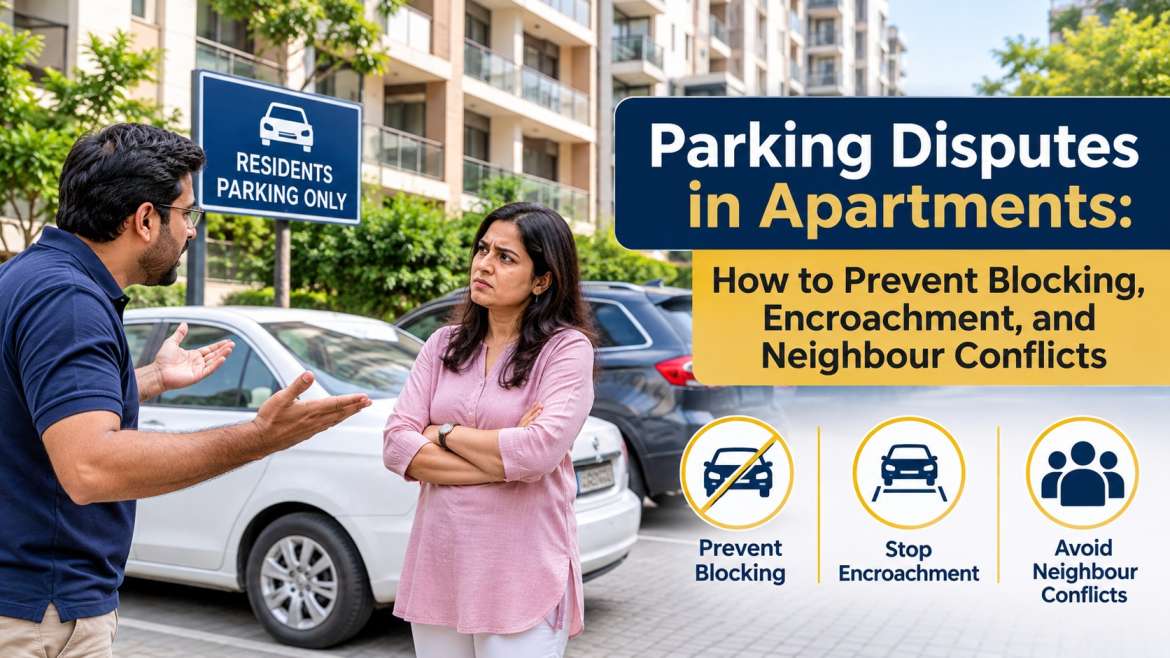
It is 8:30 on a weekday morning. You are late for work, you walk down to your parking spot, and there it is: someone else’s car sitting exactly where yours should be. Or perhaps a bike is wedged in front of your bumper, or a stranger’s SUV is blocking the only way out. You knock on a few doors, nobody owns up, and the day begins with a quarrel instead of a commute.
If this sounds familiar, you are in very large company. As Indian cities add more cars than their buildings were ever designed to hold, parking disputes in apartments have become one of the biggest sources of friction in apartment complexes, builder floors, and housing societies. The good news is that most parking disputes are preventable. They almost always come down to three things: unclear rights, unwritten rules, and weak enforcement. Fix those three, and your parking area can be calm, orderly, and fair.
This guide walks you through why parking disputes happen, what to check before you buy or rent, how to set up a system that works for everyone, and what to do step by step when someone blocks or takes over your space.
Why Parking Becomes a Battleground in Apartment Buildings
Parking is a scarce resource, and scarcity creates conflict. A few patterns show up again and again.
More vehicles than spaces. A building planned in an era of one car per family now has two or three vehicles per flat. Visitors, delivery vehicles, domestic help’s two-wheelers, and a second car all compete for the same limited area.
Vague allotment. Many buyers are told verbally that they get “one parking” without a number, a location, or a document. When a dispute arises, there is nothing to point to.
Informal habits that harden into claims. A neighbour parks in a corner for years, and eventually considers it theirs. When the real owner returns with a new car, a fight begins.
Poor design. Narrow turning radius, columns in awkward places, tandem slots where one car traps another, and entrances shared with fire lanes all make blocking almost inevitable.
No consequence for breaking rules. If a society has a rule but never enforces it, the rule is just a suggestion. People quickly learn that nothing happens when they park in someone else’s spot.
Understanding these root causes of parking disputes in apartments matters because it shows where the solutions lie. You do not need to out-argue your neighbour; you need clarity, documentation, and a fair process.
Know Your Parking Rights Before You Buy or Rent
The best time to prevent a parking dispute is before you sign anything. Whether you are buying a flat, a builder floor, or renting one, ask these questions first.
Is the parking allotted, or is it open?
Allotted parking means a specific space is assigned to your flat, ideally numbered and marked on a layout plan. Open or common parking means vehicles park on a first-come, first-served basis. Open parking is far more likely to produce disputes, because nobody has a defined claim to any spot.
Is it covered, stilt, basement, or open-air?
The type of parking affects both your rights and the rules that apply to it. Basement and stilt parking are generally part of the building design, while open-air parking is often treated as common area for residents’ use. In many states, the rules on whether covered or stilt parking can be sold separately differ, and court decisions and state laws have addressed this. Do not assume; verify the position for your state and project.
Is it written down?
Check that the following documents clearly mention your parking:
- The builder-buyer agreement or agreement to sell
- The sale deed or conveyance deed
- The allotment letter with a parking number
- The approved layout or parking plan
- The society or association bye-laws, if any
If the parking is mentioned only in a brochure or a verbal promise, ask for it to be added in writing. A line such as “one covered car parking space, number P-14, located on the lower basement” is worth far more than any assurance from a salesperson.
What does the RERA-registered project say?
For projects registered under RERA, the approved plans and the disclosures made on the state RERA portal are an important reference. They typically show how many parking spaces the project provides and how they are categorised. If the allotment you are promised does not match the registered details, raise it before you pay.
If you are renting
Tenants should have the parking space written into the rental agreement: which slot, for which vehicle, and whether a second vehicle is allowed. Check with the landlord and the society whether tenant vehicles need a sticker or registration.
Set Up a Clear Parking System in Your Society
If you live in an existing building, the most powerful thing you can do is move the community from informal habits to a written system. Here is how.
1. Number and mark every slot
Each allotted space should have a clear number painted on the floor and, if possible, a small board or wall sign. This one step removes a huge amount of ambiguity. When a car is in slot 14, anyone can check who owns slot 14.
2. Maintain a parking register
The association should keep a simple register or spreadsheet that records:
- Flat number and owner or tenant name
- Allotted slot number(s) and type (car, two-wheeler)
- Vehicle registration number(s)
- Contact number for emergencies
This register becomes the single source of truth. It also helps security staff identify vehicles that do not belong.
3. Use vehicle stickers or RFID tags
Issue a sticker, hologram, or RFID tag for every registered vehicle, linked to the flat number. Security can then quickly see which cars are residents’ and which are not. For larger complexes, boom barriers with RFID readers make unauthorised entry much harder.
4. Separate resident and visitor parking
Marking a few dedicated visitor slots, clearly labelled, prevents guests from drifting into residents’ spaces. Set a time limit for visitor parking, and require guard registration at the gate.
5. Keep two-wheelers and cars in their own zones
Scooters and bikes tend to fill gaps between cars, which block access and create resentment. A separate two-wheeler zone keeps lanes open and reduces damage complaints.
6. Protect fire lanes and common passages
Drive lanes, ramps, fire exits, staircases, lift lobbies, and generator or water tank access points must stay clear at all times. Mark them with yellow hatching and “No Parking” boards. This is both a safety requirement and a practical way to prevent “temporary” parking that turns into permanent obstruction.
Write Parking Rules Every Resident Can Follow
Rules should be short, specific, and approved by the members, ideally at a general body meeting, so that nobody can say they were never consulted. A good parking policy usually covers the following.
- One slot per flat as a baseline, with a clear process for allocating extra slots by rotation, lottery, or paid permit if spaces are available
- No parking outside your own slot, including partly on a neighbour’s space or on the lane
- No storage of junk, old vehicles, or construction material in parking areas
- No permanent installation of locks, bollards, chains, or barriers on shared or common areas without written approval from the association
- Visitor parking limits, including hours and registration
- Rules for commercial vehicles, such as taxis, vans, and delivery trucks
- Electric vehicle charging rules, covering who may install a charger, how electricity is metered, and which slots are eligible
- Penalties and a procedure for violations, from warning to fine to towing, in line with the bye-laws and local law
Once the rules are approved, circulate them in writing, display them at the gate and in the parking area, and share them on the residents’ group.
A note on parking barriers and locks
Many owners protect their space with a floor lock, a chain, or a drum placed in front of the slot. If the slot is clearly allotted to you, a removable lock within your own boundary may be acceptable under your society’s rules. But placing an obstacle in a shared lane, or on a space that is not exclusively yours, can itself cause a dispute. Check the bye-laws, and when in doubt, ask the association for written permission.
How to Handle Blocking and Encroachment Step by Step
Even in a well-run building, someone will occasionally park where they should not. How you respond in the first 48 hours often decides whether the problem is solved quickly or becomes a long feud. Follow the steps in order, and stay calm.
Step 1: Document everything
Before you do anything else, take clear photographs or a short video showing the vehicle, its number plate, and the slot number. Note the date and time. If this has happened before, keep a log. Evidence turns a he-said, she-said argument into a simple factual matter.
Step 2: Check your own paperwork
Make sure you are certain the space is yours. Look at your allotment letter, your sale deed, and the parking register. Being confident about your rights lets you speak politely and firmly.
Step 3: Talk to the neighbour, kindly
If you know who owns the vehicle, speak to them directly and politely. Many people block spaces out of carelessness, not malice: a guest parked in the wrong place, or someone who genuinely believes the slot is unused. A friendly message such as “Hi, I think your guest parked in my slot 14; could you please move the car?” solves most cases immediately.
Step 4: Involve security and the association
If the vehicle is unknown or the neighbour does not respond, inform the security guard and the RWA or facility manager. Ask them to trace the owner through the parking register or the vehicle sticker, and to make an announcement if needed.
Step 5: Send a written notice
If the problem repeats, send a short, polite written complaint to the association, with your photographs attached. Ask for a written response and a timeline. A paper trail is valuable if you later need to escalate.
Step 6: Escalate to the managing committee
Repeated violations should go to the managing committee or the general body. The committee can issue a warning letter, levy a fine as per the bye-laws, restrict facilities in extreme cases, or arrange for the vehicle to be towed where the rules allow it.
Step 7: Use mediation
Before going to court, consider mediation. A neutral mediator, a respected senior resident, or a mediation centre can often find a practical compromise faster and at a much lower cost than litigation.
Step 8: Approach the authorities, if needed
When a vehicle is blocking a public road or gate, you can contact the local traffic police. For disputes about ownership of a parking space, a builder’s failure to deliver the promised parking, or violation of an agreement, you may need to approach the state RERA authority, the consumer commission, or a civil court. Because procedures and remedies differ by state and by project, consult a qualified property lawyer before filing anything.
What Not to Do
In the heat of the moment, a few reactions make things worse.
- Do not damage or deflate a vehicle’s tyres. This can expose you to a criminal complaint and instantly turns you from the wronged party into the wrongdoer.
- Do not block the other person’s car in retaliation. Two wrongs create a bigger dispute.
- Do not post accusations or personal details on social media or group chats. Keep complaints factual and routed through proper channels.
- Do not take the law into your own hands by removing someone’s barrier or moving their vehicle without authority.
Calm, documented, and procedural responses win disputes. Heated ones lose them.
Smart Design and Technology Solutions
Modern tools can prevent many problems before they begin.
- Automated number plate recognition (ANPR) cameras at the gate record every entry and exit, creating a reliable record.
- Parking management apps let residents register vehicles, invite visitors with time-limited passes, and report violations with photos.
- Slot sensors and digital displays show which slots are occupied in larger basements.
- CCTV coverage of parking areas deters misuse and provides evidence.
- Dedicated EV charging bays prevent conflicts around charging points.
- Mechanical or stack parking can increase capacity in tight sites, though they need clear usage rules and maintenance.
Technology does not replace good rules, but it makes enforcement consistent and removes the awkwardness of one neighbour policing another.
Special Situations Worth Planning For
Builder floors and independent houses
In builder floors, each floor is often owned separately, and the stilt or front-of-house parking is shared among the owners. Written understanding on who parks where, whether the arrangement is fixed or rotating, and who can use the visitor space is essential. Put it in the sale deed or a registered agreement among the owners.
Gated communities with multiple towers
Large complexes should allocate parking tower-wise or block-wise, with clear signage and separate rules for each zone. An overall master plan, shared with all residents, avoids tower-to-tower disputes.
Redevelopment and renovation
During construction or repair work, temporary parking changes cause the most confusion. Announce changes well in advance, mark temporary slots, and record who has been moved where.
Selling or renting your flat
When you sell, ensure that your parking allotment transfers with the flat in writing. When you rent out, put the parking terms in the tenancy agreement so that the tenant knows exactly which slot is theirs.
A Simple Checklist for Peaceful Parking
Use this quick list to check how well your building is protected against parking disputes in apartments.
- Is every allotted slot numbered and marked on the floor?
- Is the parking mentioned in your agreement, sale deed, or allotment letter?
- Does the association keep an updated parking register?
- Do all resident vehicles carry a sticker or tag?
- Are visitor slots separate and time-limited?
- Are fire lanes and passages clearly marked and kept clear?
- Are the rules written, approved, and displayed?
- Is there a clear penalty and complaint procedure?
- Is there CCTV or gate-level vehicle tracking?
- Is there a mediation route before legal action?
If you answered “no” to more than three of these, your building is vulnerable to parking conflicts, and it is a good time to raise the topic at the next general meeting.
Frequently Asked Questions
Can a neighbour park in my allotted parking space if it is empty?
Not without your permission. If the space is formally allotted to you, it is for your use. Some owners voluntarily allow neighbours to use it while they are away, but this should be informal, temporary, and preferably confirmed in writing so that no permanent claim arises.
Can the society change my allotted parking slot?
That depends on your agreement and the society’s bye-laws. A change that affects an allotted slot generally needs your consent or a proper decision by the general body. If you did not agree, raise a written objection.
Who is responsible if my car is damaged in the parking area?
Responsibility depends on the cause. If a neighbour’s vehicle caused the damage, they are liable, and your motor insurance may cover it. Societies usually state in their rules that the association is not responsible for theft or damage unless it has expressly taken on that duty. Keep your insurance current and report incidents promptly.
Can I charge an EV in my parking slot?
Many societies now permit it, subject to safe wiring, a separate meter, and committee approval. Check your bye-laws, and apply in writing before installing a charger.
What if the builder did not give me the parking promised in my agreement?
Gather your agreement, payment receipts, and correspondence. You can raise the issue with the builder in writing, and if it is not resolved, approach the state RERA authority or a consumer forum. A property lawyer can advise on the best route.
Final Thoughts
Parking disputes in apartments can feel intensely personal, but they are rarely about the parking itself. They are about fairness, respect, and the feeling that your rights count. A building that treats parking as a matter of clear documents, shared rules, and consistent enforcement spares its residents years of stress.
If you are a buyer, insist on written, numbered parking before you commit. If you are a resident, work with your neighbours to number the slots, keep a register, and agree on rules everyone can live with. And if someone blocks your space, document it, stay courteous, and use the proper channels. A few hours of preparation now can save you from a morning like the one we began with, for as long as you live there.


