
For property owners redeveloping family plots or investors building bespoke, ultra-luxury independent floors in South Delhi’s premium colonies—such as Anand Niketan, Vasant Vihar, Shanti Niketan, Greater Kailash, and Panchsheel Park—regulatory compliance has evolved far beyond a routine administrative exercise. It is now a highly sensitive, legally binding operational paradigm overseen by the Supreme Court of India, the Delhi Pollution Control Committee (DPCC), and the Commission for Air Quality Management (CAQM).
As the winter season of 2026–2027 progresses, the environmental enforcement apparatus has shifted from a chaotic, reactive emergency measure to a highly organized, predictable, and stringently enforced multi-tiered framework. Navigating this regulatory landscape without facing catastrophic stop-work orders or crippling financial penalties requires a deep, uncompromising understanding of the Graded Response Action Plan (GRAP) laws. For a high-end home builder in South Delhi, knowing the exact fine print between an explicitly illegal task and a legally permissible indoor activity is the ultimate differentiator between project success and operational paralysis.
Demystifying the GRAP Framework for Residential Developments
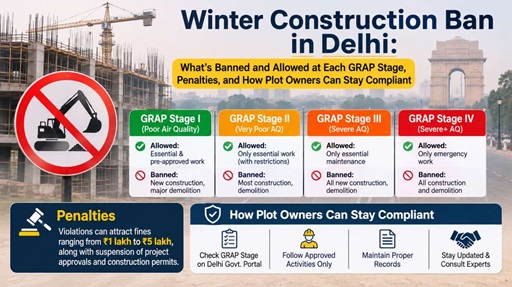
The Graded Response Action Plan is structured as a progressive four-stage schedule that triggers automatically based on the rolling air pollution metrics measured across Delhi’s automated monitoring grid. Each stage directly alters what a builder can do on a residential plot.
GRAP Stage I (AQI 201 to 300 – ‘Poor’)
This is the foundational baseline phase activated at the onset of autumn. While all primary construction work remains fully legal, the site must transition immediately into a highly managed environment.
- The Legal Mandate: Open storage of any loose building materials—including sand, un-bagged cement, un-bonded soil, or brick kiln debris—is strictly prohibited. All material piles must be completely covered with water-resistant, heavy-density tarpaulins.
- Transportation Logistics: Materials can only be transported to the site in commercial vehicles that are fully sheeted and sealed at the top. Any truck dropping aggregates that releases visible plumes of dust can be impounded on the spot by transport department flying squads.
GRAP Stage II (AQI 301 to 400 – ‘Very Poor’)
When the air quality drops into the “Very Poor” band, the enforcement focus shifts to dust suppression and mechanical emissions.
- Operational Restrictions: Mechanical stone cutting, dry marble grinding, and concrete surface chasing are completely banned unless performed inside a closed room equipped with continuous water-injection dust-suppression machinery.
- Site Infrastructure: The builder must ensure daily water-sprinkling routines on all unpaved common walkways and surrounding approach roads to prevent vehicular traffic from kicking up fine silt.
GRAP Stage III (AQI 401 to 450 – ‘Severe’)
This is the critical phase that disrupts unorganized real estate developers. Stage III represents a comprehensive, non-negotiable ban on all primary outdoor civil engineering and dust-generating construction activities across the National Capital Region.
- Explicitly Banned Actions: Heavy excavation, structural piling, earthwork, structural RCC casting, brick masonry layout, external wall plastering, and open-air demolition are completely illegal.
- Logistical Freeze: The entry of heavy commercial dump trucks and interstate supply vehicles carrying non-essential construction components into Delhi municipal boundaries is completely blocked.
GRAP Stage IV (AQI > 450 – ‘Severe Plus’)
The ultimate emergency tier. Under Stage IV, a total environmental emergency is declared.
- The Full Lockdown: All major public infrastructure works (which are typically exempted under Stage III, such as Metros, flyovers, and national highways) are completely frozen. For residential plots, even the transport of light internal finishing components via light commercial vehicles (LCVs) faces extreme restrictions, and municipal corporations deploy round-the-clock drone surveillance to identify any unauthorized human movement or material handling across micro-neighborhoods.
The Spatial Realities of Building in Micro-Neighborhoods
Developing an independent luxury floor in South Delhi is structurally distinct from executing a sprawling high-rise project in the suburbs of Noida, Greater Noida, or Gurugram. In master-planned suburban developments, sites feature wide setbacks, massive storage yards, and a substantial buffer zone separating the construction activity from residential spaces.
In South Delhi, the reality is compact, highly dense, and spatially constrained:
- Zero Boundary Cushions: A typical 200, 300, or 500 square yard residential plot in areas like Lajpat Nagar, Green Park, or Kailash Colony sits directly flush against adjacent, fully occupied multi-story builder floors. The margin of error is zero. Any airborne plume of dust generated by careless tile cutting or sloppy soil management drops directly into a neighbor’s balcony, courtyard, or air conditioning intake filter.
- Vigilant RWA Networks: Resident Welfare Associations (RWAs) in South Delhi are exceptionally well-informed, legally organized, and highly proactive. Under modern environmental governance, any citizen can capture a real-time photograph of dust emission or un-sprinkled construction debris and upload it instantly to the government’s Green Delhi App. These mobile uploads bypass traditional red tape, routing directly to localized DPCC flying squads who are mandated to visit the coordinate location within hours to issue immediate cease-and-desist orders.
The Legal and Financial Stakes of Compliance
For a property owner or a development partner, violating GRAP guidelines is an incredibly expensive mistake that extends far beyond a simple fine. The modern enforcement matrix uses a strict polluter-pays principle that can completely alter the financial dynamic of a project.
The Environmental Compensation Structure
The DPCC and municipal corporations deploy dedicated teams equipped with laser particulate counters. If a site is found operating during an active Stage III ban, or if a site is found handling materials without dust-control barriers during Stage II, the penalties are swift:
- Statutory Fines: Non-negotiable environmental compensation penalties starting at ₹50,000 for minor dust management failures, escalating rapidly to ₹5 Lakhs to ₹10 Lakhs for unauthorized structural concrete pouring or deep mechanical excavation during a ban window.
- Criminal Liability: Under the Air (Prevention and Control of Pollution) Act, persistent non-compliance or deliberate tampering with sealed site gates can lead to direct criminal show-cause notices against the designated project directors and landholders.
- Long-Term Blacklisting: A site issued a structural stop-work seal by the DPCC faces a multi-week bureaucratic resolution pathway. Even after paying the financial penalty, obtaining a formal de-sealing order requires physical inspections, structural status reviews, and formal affidavits, causing the site to remain completely frozen long after the city-wide pollution ban has been officially lifted.
The Grovy India Defensive Compliance Framework
To protect our clients’ capital investments, ensure absolute peace of mind for the surrounding neighborhood, and preserve unblemished legal standing, Grovy India implements an advanced, proactive defensive compliance strategy that exceeds standard municipal mandates.
- The 20-Foot Industrial Boundary Shield
Before a single shovel touches the soil at any Grovy site in South Delhi, the entire perimeter of the plot is wrapped in heavy-gauge, structural steel sheets standing a minimum of 20 feet high. This rigid wall is continuously lined with a high-density, multi-layered green agro-netting matrix. This double-barrier design acts as an absolute physical filter, ensuring that any localized micro-dust generated by permissible internal work is fully contained within the plot boundary and never escapes into the neighborhood air.
- High-Pressure Water-Misting Infrastructure
Every ongoing Grovy residential build is permanently equipped with automated, high-pressure fine-droplet water-misting cannons and industrial perimeter sprinklers. These systems break down water molecules into an ultra-fine fog that actively binds with suspended particulate matter (PM2.5 and PM10), forcing it to drop out of the air instantly rather than drifting into adjacent structures. During GRAP Stage II and III windows, these units operate on pre-programmed hourly cycles along the site boundaries.
- Digitized Micro-Climate Auditing
Our on-site civil engineers do not rely on city-wide air quality reports published in the next day’s newspapers. Every Grovy project director carries calibrated, hand-held optical particle counters to monitor the air quality directly within the active working zones. If internal PM counts begin to rise toward the threshold, indoor work is immediately throttled, and air scrubbers are activated to clean the indoor environment before any dust can settle or migrate outward.
- Hermetic Basements and Structural Material Containment
We completely eliminate the primitive practice of piling loose building materials on municipal sidewalks or open driveways. All aggregates, fine sands, and brick modules are containerized and transitioned directly into the building’s reinforced concrete basements. By storing our operational components deep within a sealed underground structure, we ensure they remain completely out of the wind, out of sight of regulatory patrols, and perfectly preserved from the winter humidity.
By understanding the exact legal realities of the GRAP framework and deploying institutional-grade engineering protections, Grovy India ensures that your luxury residential redevelopment project moves forward cleanly, legally, and in perfect harmony with the environment and the South Delhi community.


