
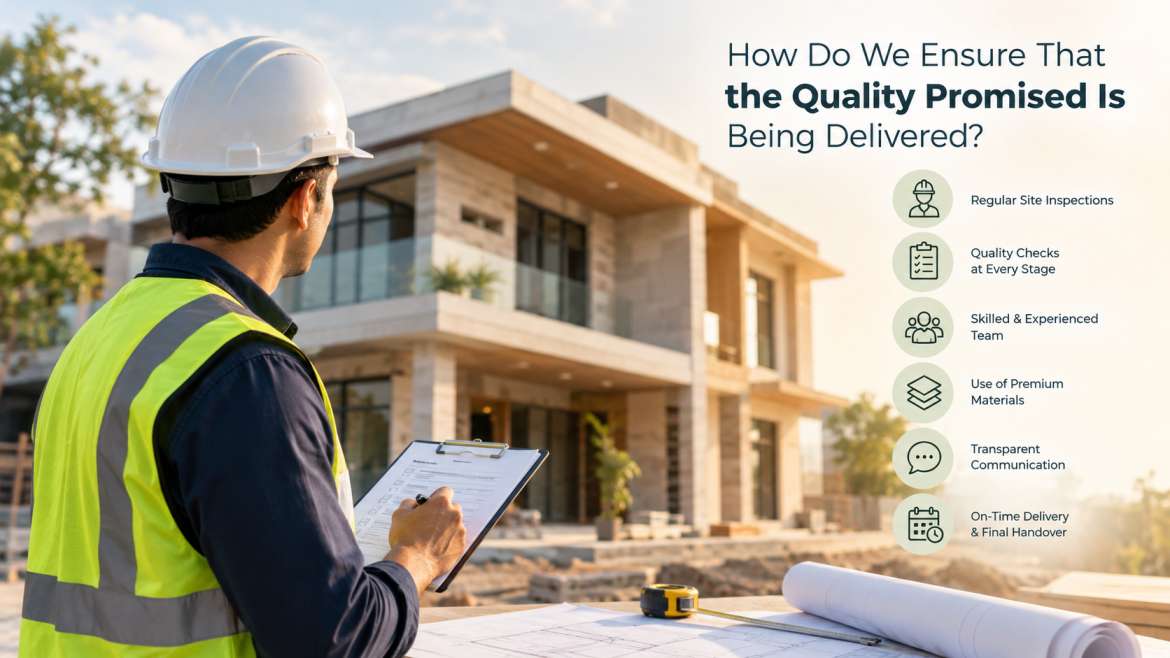
When it comes to constructing or redeveloping a home, one of the biggest concerns for a homeowner is simple: Will the quality promised at the beginning actually be the quality delivered at the end?
A specification sheet can mention premium materials. A discussion can cover brands, finishes, fixtures and construction standards. But the real measure of quality is what ultimately gets built on site.
At Grovy, we believe that quality cannot be achieved through promises alone. It has to be planned, monitored, documented and verified at every stage of construction.
Our approach to construction is therefore process-driven, with a focus on planning, defined specifications, continuous monitoring and regular quality checks. From the initial planning stage to the final handover, multiple layers of checks help ensure that the quality agreed upon is consistently translated into execution.
As a real estate developer in Delhi with decades of experience in luxury residential construction, we have built this process around one idea: what is promised must match what is delivered.
Here is how we approach it.
1. Quality Starts With Planning, Not Construction
Quality is not something that can be added at the end of a project. It begins much before the first brick is laid.
Construction is planned strategically based on the requirements of the project, site conditions, design and execution methodology. Our experience in residential construction and redevelopment helps us anticipate the practical requirements of a project before construction progresses.
Even before design begins, it helps to understand how much can be built on your plot. Our FAR calculator gives landowners a quick estimate of permissible built-up area under the applicable Floor Area Ratio, so planning starts with realistic numbers.
A well-planned construction process reduces ambiguity on site and allows different activities to be executed in a coordinated manner.
The objective is simple: define the process before execution begins. This is also what separates the best turnkey construction builder from one that makes decisions only when problems appear on site.
This includes planning materials, construction activities, timelines, quality checkpoints and responsibilities so that the project progresses in a structured manner rather than relying on decisions being made only when an issue arises on site.
2. Specifications Are Frozen at the Beginning
One of the most important steps in ensuring consistent quality is establishing clear specifications before construction begins.
At the beginning of a project, the construction specifications are discussed and finalised. This includes the brands, materials, products and finishes that are proposed to be used across different parts of the property.
Why is this important?
Because quality can become subjective if there is no clearly defined benchmark.
For example, simply saying that a project will use “premium sanitary fittings” leaves considerable room for interpretation. But when the specific brand, product category and specification are established beforehand, there is a defined reference point for execution.
The same principle applies across various construction elements.
Once specifications are frozen, they become a benchmark against which procurement and execution can be checked.
This creates greater clarity for everyone involved — the homeowner, project team, consultants, contractors and other stakeholders.
In a turnkey project, where one team handles design, materials, execution and handover, frozen specifications are what keep every stage accountable. This is why the best turnkey construction builder is the one that defines these benchmarks in writing before work starts.
3. Quality Is Monitored Throughout the Construction Process
A common misconception is that quality control happens only when construction is nearing completion.
In reality, by that stage, correcting certain issues can be difficult, expensive or disruptive.
That is why quality needs to be monitored throughout the construction journey.
Our project teams undertake regular checks as construction progresses. Different stages of work are reviewed to ensure that execution is aligned with the approved design, specifications and construction requirements.
This ongoing monitoring allows issues, if identified, to be addressed at the appropriate stage rather than being discovered after the work is complete.
The idea is straightforward:
Don’t wait until the end to check the quality of what has already been built.
4. Constant Monitoring Through Regular Site Visits
Construction is ultimately executed on site, which makes physical monitoring an important part of quality assurance.
Regular site visits allow the team to observe the actual progress of work, coordinate with the people executing the project and review whether construction is progressing according to the planned requirements.
Site visits also provide an opportunity to assess aspects that cannot be fully understood through drawings, photographs or reports alone.
Our approach involves continuous involvement and personal attention through regular visits to the project site.
This helps maintain a connection between planning and execution.
For a homeowner, this also provides greater confidence that the project is not simply being left to progress without supervision.
5. Multiple Quality Checks Instead of One Final Inspection
Quality is not a single checkpoint.
A home passes through multiple construction stages, and each stage has its own requirements and potential areas of concern.
Therefore, our quality approach incorporates checks at different stages of construction.
These checks can broadly be viewed through three phases:
Pre-Construction Checks
Before construction begins, the project is reviewed from a planning and specification perspective.
This includes establishing the scope of work, freezing construction specifications, finalising materials and brands, reviewing drawings and planning the execution process.
The objective is to create clarity before work begins.
During-Construction Checks
Once construction starts, ongoing monitoring and inspections become important.
Work is reviewed at different stages to ensure that execution follows the planned specifications and requirements.
The focus is not only on the final appearance but also on the construction process behind it.
Post-Construction Checks
Once the major construction activities are complete, the property goes through further checks before completion and handover.
The objective is to identify any pending work, finishing requirements or issues that need attention before the project is considered complete.
Together, these three stages create a more structured approach to quality management.
6. Documentation Makes Quality More Transparent
Good construction management is not only about what happens on site. It is also about maintaining a clear record of what is happening.
For every project, a monthly project report is prepared and shared.
These reports help provide visibility into the progress of construction and the various activities being undertaken.
For homeowners, regular reporting can answer some of the most common questions during construction:
- What has been completed?
- What is currently being worked on?
- What comes next?
Regular documentation creates accountability and helps keep all stakeholders aligned.
Instead of relying only on occasional conversations or site visits, there is a structured mechanism for communicating project progress.
7. Personal Attention Matters
Every construction project has its own challenges.
Site conditions can vary. Designs can have specific requirements. Different stages of construction require coordination between multiple teams.
This is where personal attention becomes important.
Regular involvement from the project team allows decisions to be made with a better understanding of the actual site conditions and project requirements.
Our approach is not simply to define specifications and then step away. We believe construction quality requires continued involvement throughout the project.
Regular visits, monitoring and coordination help bridge the gap between what was planned and what is actually being executed.
This is especially important in collaboration construction, where the landowner and builder work together on the project. Regular communication and shared visibility keep both parties aligned from the first drawing to the final handover.
8. Homeowners Can Also Have Independent Oversight
Transparency becomes stronger when homeowners have visibility and involvement in the process.
Depending on their preference, homeowners can also appoint someone to monitor the construction and provide an additional layer of oversight.
In a collaboration construction model, this transparency matters even more, since the homeowner is an active partner in the project rather than a passive client.
This can be particularly useful for homeowners who may not be able to visit the site regularly themselves.
An independent person appointed by the homeowner can observe progress and coordinate observations with the relevant project stakeholders.
For us, quality assurance is not about limiting visibility. It is about creating a process where the homeowner has confidence in what is being executed.
9. The Finished Project Is the Final Test
Ultimately, the strongest demonstration of construction quality is the completed project.
This is why we believe in showcasing our completed projects.
A completed project allows homeowners and prospective clients to see the actual outcome of the construction process rather than relying only on drawings, specifications or proposed finishes.
It provides an opportunity to observe the quality of execution, detailing, finishes, functionality and overall workmanship in a real completed environment.
In other words, the finished project becomes a reference for the quality we aim to deliver, and for many homeowners, a completed home is the best way to judge a real estate developer in Delhi.
10. Quality Is About Consistency, Not Just Premium Materials
It is easy to associate quality with expensive materials or premium brands.
But quality construction involves much more than the materials used.
A premium product, if incorrectly installed, may not deliver the intended performance. Similarly, even good design requires disciplined execution to achieve the desired result.
That is why our approach considers quality as a combination of:
Planning + Specifications + Materials + Execution + Monitoring + Inspection + Documentation
Each element contributes to the final outcome.
The objective is not simply to use good materials, but to ensure that the entire construction process is controlled and monitored.
Building Trust Through a Defined Process
For a homeowner, constructing or redeveloping a property is a significant decision. The finished home is not just a structure — it is a long-term investment in comfort, safety and everyday living.
Naturally, homeowners want confidence that what has been discussed and promised at the beginning will be reflected in the final property.
That confidence cannot come from words alone.
It comes from having a defined process.
At Grovy, our approach is built around this principle. We establish specifications at the beginning, plan construction strategically, monitor execution through regular site visits, conduct checks before, during and after construction, maintain project reporting and provide visibility into completed projects.
We also recognise that homeowners may want an additional level of oversight, which is why they can choose to appoint someone to independently monitor the project.
Whether you are exploring turnkey construction, collaboration construction, or redevelopment with a trusted real estate developer in Delhi, our goal is the same.
The purpose of all these measures is the same:
To create a clear connection between what is promised, what is planned and what is ultimately delivered.
Because in construction, quality should not be something that a homeowner discovers only after the keys are handed over.
It should be a process that is visible throughout the journey.
Quality is not just a promise. It is a process — planned, monitored and delivered.