
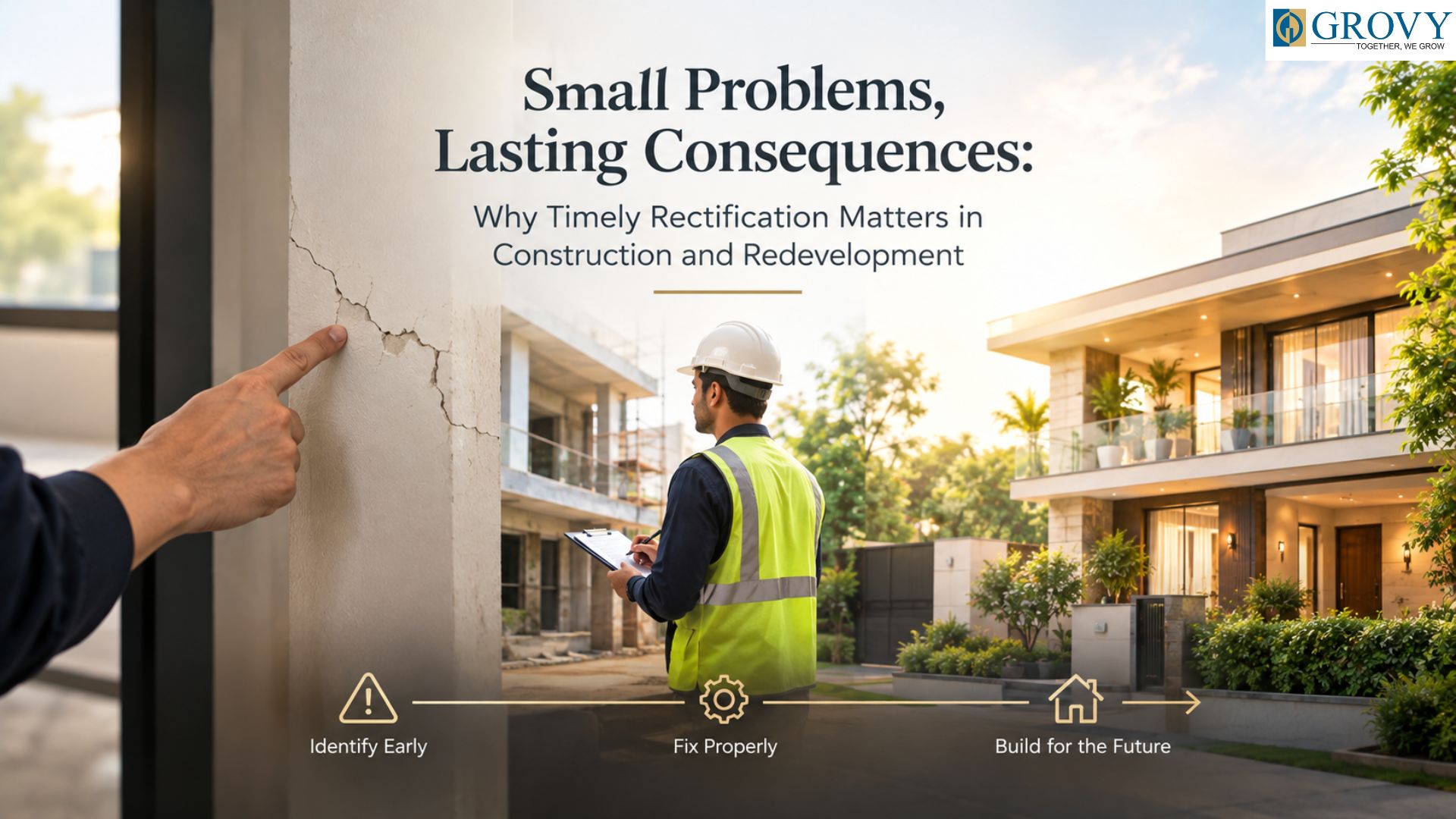
In construction and redevelopment, the difference between a well-managed project and a complicated one often lies in how early problems are identified and addressed. A minor issue, when noticed at the right time, may require only a simple correction. The same issue, if overlooked or repeatedly postponed, can gradually develop into a larger concern that demands considerable time, effort, and resources to resolve.
This principle extends beyond construction. Every project involves decisions, coordination, planning, and execution, and challenges are an inevitable part of the process. What truly matters is the approach taken towards these challenges. Are they addressed at their source, or are temporary solutions used to keep things moving? Are lessons from previous experiences incorporated into future processes, or are the same mistakes allowed to recur?
At Grovy India Limited, our experience in South Delhi’s residential redevelopment sector has reinforced the importance of identifying concerns early, understanding their underlying causes, and working towards lasting solutions. We believe that responsibility does not end with completing a project or handing over a home. A commitment to quality also means remaining attentive to concerns, learning from experience, and continuously improving the processes that shape the homes we build.
Why Small Problems Should Never Be Ignored
Most significant problems rarely emerge without warning. In many cases, they begin as small observations, minor inconsistencies, or early signs that something is not working as intended. The difficulty is that these signs can appear insignificant when viewed in isolation.
A slight variation in a construction detail, an unresolved coordination issue, or a gap in communication may not immediately affect the overall progress of a project. However, when such issues are left unattended, they can influence other activities, create dependencies, and become more difficult to correct as work progresses.
Consider a simple example from construction. If a waterproofing concern is identified during the appropriate stage, it can be investigated and corrected before subsequent finishes are installed. If the same concern remains unnoticed until the area is fully finished and occupied, resolving it may require removing completed work, identifying the source of moisture, carrying out repairs, and restoring the affected surfaces.
The original concern may have been relatively straightforward. Its consequences, however, become considerably more complicated because the opportunity for an early intervention was missed.
This is why timely rectification should not be viewed as an additional task. It is an essential part of responsible project management. Addressing an issue promptly protects the work already completed, reduces avoidable rework, and helps maintain the intended quality of the final outcome.
The Real Challenge Is Finding the Root Cause
Identifying a problem is only the first step. The more important task is understanding why it occurred in the first place.
When an issue arises, the immediate tendency may be to correct what is visible. While this can sometimes provide temporary relief, it does not necessarily eliminate the underlying cause. If the source remains unresolved, the same concern may return, potentially in a different form or at a later stage.
In residential construction, for instance, a damp patch on a wall may appear to be a surface-level problem. Repainting the affected area might improve its appearance temporarily, but it will not provide a lasting solution if water is entering through a defective waterproofing layer, a plumbing leak, or an inadequately sealed joint.
A more effective approach involves investigating the affected area, tracing the source of the moisture, determining the reason for the failure, and implementing the appropriate corrective measures before restoring the finish.
The same approach applies to project coordination and communication. If repeated misunderstandings occur between different stakeholders, resolving each misunderstanding individually may not be enough. The underlying process may need to be reviewed. Perhaps responsibilities are unclear, decisions are not documented, or updates are not reaching the right people at the right time.
Root-cause correction shifts the focus from repeatedly managing symptoms to preventing the problem from recurring.
It also requires patience and technical judgement. Not every visible defect has an obvious explanation, and not every correction can be made immediately without further investigation. The objective is to understand the issue properly and select a solution that addresses its cause rather than simply improving its appearance.
Why Delayed Rectification Becomes More Difficult
Time changes the nature of a problem. In construction, each completed stage often depends on the successful completion of the previous one. Once work moves forward, access to earlier components becomes more restricted, and correcting an overlooked issue may disturb several activities that have already been completed.
This is one reason why inspections, checks, and approvals must take place at the appropriate stages rather than being postponed until the end of a project.
Before a wall is closed, concealed services and relevant installations can be inspected. Before a finished surface is installed, the underlying work can be checked. Before an area is handed over, its functionality and finish can be reviewed. Each stage offers an opportunity to identify concerns while the relevant components remain accessible.
Missing these opportunities can increase the complexity of rectification. A defect that once required a local correction may later involve dismantling finished work, coordinating multiple teams, sourcing replacement materials, and managing disruption to the project schedule.
In some situations, delayed intervention can also allow damage to spread. Moisture may affect adjacent finishes, an unresolved drainage issue may create recurring inconvenience, or a small installation error may interfere with the performance of connected components.
Not every problem becomes irreversible, but some consequences become disproportionately expensive or disruptive to undo. In other cases, the original condition may no longer be recoverable without substantial reconstruction.
The lesson is straightforward: the earlier a concern is properly addressed, the greater the opportunity to correct it with minimal disruption.
Timely Action is as Important as Quality Planning
Good planning reduces the likelihood of problems, but planning alone cannot eliminate every uncertainty. Construction involves multiple activities, different materials, changing site conditions, and coordination among several teams. Even with established procedures, issues can arise during execution.
This makes timely monitoring particularly important.
A project should not depend solely on identifying defects at the final inspection. Quality needs to be assessed throughout the construction process, with checks aligned to the work being carried out. Observations should be recorded, responsibilities should be clearly assigned, and corrective actions should be followed through until the issue has been adequately resolved.
Equally important is the willingness to pause and investigate when necessary. Continuing work merely to maintain the schedule can sometimes create greater delays later. A short intervention at the right stage may prevent extensive corrective work after several subsequent activities have been completed.
Effective project management therefore requires a balance between progress and precision. Moving quickly is valuable only when the work being completed meets the required standards. The objective is not simply to finish each stage on time, but to ensure that every stage provides a dependable foundation for the next.
Quality Is Built Through Continuous Attention
Quality is often associated with the materials used, the specifications followed, and the final appearance of a completed home. These factors matter, but quality is also determined by the discipline with which work is monitored and concerns are resolved.
A carefully selected material cannot compensate for incorrect installation. A well-designed space cannot deliver its intended performance if important construction details are overlooked. Similarly, a visually impressive finish cannot substitute for the proper functioning of concealed systems.
For this reason, quality assurance must extend beyond the final appearance of a property. It involves checking workmanship, verifying installations, monitoring execution, and ensuring that the work corresponds with the agreed specifications.
In residential redevelopment, where homeowners place considerable trust in the developer, these practices are particularly important. The homeowner may not be present at every stage or possess the technical expertise to assess every construction detail. A structured process of inspection and rectification helps bridge this gap.
At Grovy India Limited, we believe that delivering a home involves more than completing construction activities. It requires attention to the details that contribute to the property’s long-term functionality, comfort, and reliability. The objective is to identify concerns when they can still be addressed effectively and to avoid allowing preventable issues to pass unnoticed from one stage to another.
Responsibility Does Not End at Handover
The completion of a project marks an important milestone, but it does not make the homeowner’s experience any less important afterwards.
Once a home is occupied, certain concerns may become apparent through regular use or changing conditions. An issue that was not evident during an initial inspection may require further investigation. A homeowner may also need guidance regarding a component, an installation, or the appropriate way to maintain a particular feature.
Such situations call for a responsible and constructive approach.
The first step is to understand the concern clearly. This may involve examining the issue, determining whether it relates to workmanship, material performance, maintenance, or another factor, and identifying the appropriate course of action. Where a correction is required, the objective should be to resolve the matter effectively rather than merely provide a temporary response.
Post-handover support also reinforces the importance of communication. Homeowners should have a clear understanding of whom to approach, what information may be required, and how the concern will be assessed. Timely responses help prevent uncertainty from becoming frustration.
Of course, every issue has its own circumstances, and the appropriate response depends on its nature, cause, and applicable commitments. Nevertheless, a willingness to listen, investigate, and guide the homeowner reflects a broader commitment to the relationship.
For a developer, this stage provides an opportunity to understand how a home performs beyond the construction site. It offers insights that may not be available through inspections alone and helps connect the construction process with the homeowner’s actual experience.
Every Resolved Problem Should Improve the Next Project
Rectifying an issue is important, but preventing its recurrence is equally valuable.
When a concern is resolved, the process should not end with the immediate correction. It is worth examining what allowed the issue to occur and whether a change in planning, supervision, documentation, coordination, or execution could reduce the likelihood of a similar occurrence in the future.
For example, if an installation concern repeatedly arises at a particular stage, the inspection procedure for that stage may need to be strengthened. If a specification is frequently misunderstood, clearer documentation or better communication may be required. If coordination gaps result in avoidable rework, responsibilities and approval procedures may need to be reviewed.
These improvements can then become part of the standard working process. Checklists can be updated, inspection points can be refined, teams can be briefed, and relevant observations can be shared with the people responsible for similar activities.
This is how individual experiences contribute to organisational learning.
A problem that has been properly investigated can provide valuable information. When the findings are documented and applied, the benefit extends beyond the immediate project. Future projects can begin with better-informed procedures, clearer expectations, and stronger preventive measures.
Without this learning, even a successfully resolved issue may return in another project because the underlying weakness in the process remains unchanged.
Continuous improvement is therefore not simply about correcting what went wrong. It is about using that experience to make the next execution more reliable.
Building Trust Through Accountability
Trust in Real Estate and Construction Develops Over Time
Trust in real estate and construction develops over time. It is influenced by the quality of the work, the transparency of communication, the way commitments are managed, and the response when something does not go according to plan. For a luxury home construction company, building trust also means maintaining high standards of workmanship and accountability throughout the project.
No complex project can realistically promise that every stage will be entirely free of challenges. What matters is whether concerns are acknowledged and handled with the seriousness they deserve.
Ignoring a problem can create uncertainty, while an unexplained temporary fix may leave the homeowner questioning whether the issue has truly been resolved. A transparent process, on the other hand, demonstrates that the concern is being taken seriously and that appropriate steps are being considered.
Accountability also means recognising that the immediate solution is only part of the responsibility. Where relevant, the reasons behind the issue should inform future planning, and the lessons learned should contribute to better processes.
For homeowners considering redevelopment, this is an important consideration when evaluating a developer. Alongside design, specifications, experience, and project execution, it is worth understanding how concerns are monitored, how rectification is approached, and what support is available after completion.
A developer’s commitment to quality is reflected not only in the homes delivered, but also in the discipline and responsibility demonstrated throughout the journey.
Conclusion: Correct Early, Learn Continuously, Build Better
Every project presents challenges, and the presence of a problem does not automatically indicate failure. In many cases, the real difference lies in how the issue is recognised, investigated, and addressed.
A concern identified early can often be corrected before it affects other work. A root cause properly understood can prevent repeated repairs. A lesson documented and incorporated into future procedures can improve the reliability of subsequent projects. And a homeowner’s concern addressed responsibly after handover can strengthen the relationship long after construction is complete.
The greater risk is allowing a small issue to remain unresolved until its consequences become difficult, expensive, or sometimes impossible to reverse.
At Grovy India Limited, we believe that responsible redevelopment requires this combination of timely action, root-cause thinking, continuous learning, and sustained attention to the homeowner’s experience. As a company focused on quality-driven construction and redevelopment, we work towards creating homes that are not only thoughtfully built but also supported by a process committed to getting things right.
Because the best time to correct a problem is when it is first identified, and the best outcome is ensuring that the same problem does not have to be solved again.
Frequently Asked Questions
Why is timely rectification important in construction?
A minor issue caught at the right stage may need only a simple correction. If it is overlooked, it can affect other work, require removing finished surfaces and lead to considerably more time, effort and cost to resolve.
What does root-cause correction mean in home construction?
It means finding why a defect occurred instead of only fixing what is visible. For example, repainting a damp wall will not last if water is entering through a defective waterproofing layer, a plumbing leak or an inadequately sealed joint.
When should construction quality checks be carried out?
Checks should happen throughout construction rather than only at the final inspection. Concealed services can be inspected before walls are closed, underlying work can be checked before finishes are installed, and each area can be reviewed before handover.
What kind of support should a homeowner expect after handover?
Homeowners should know whom to approach, what information may be needed and how a concern will be assessed. The appropriate response depends on the nature and cause of the issue and applicable commitments, but timely communication and a genuine effort to resolve the cause are essential.
How do resolved defects improve future projects?
When the cause of an issue is documented and applied, inspection checklists, specifications, supervision and coordination procedures can be strengthened so that similar problems are less likely to recur in later projects.